In the world of AI application development, simple needs can often be met by directly calling LLM APIs with code. For developers learning AI, building your own framework from scratch is a valuable exercise to understand the principles.
However, for enterprise-grade applications and complex business scenarios, we need efficient, robust platforms. Currently, AI workflow platforms fall into two main categories:
- Web-based Workflow Platforms: Represented by Coze, emphasizing visualization and out-of-the-box usability.
- Code Frameworks: Represented by LangChain and LlamaIndex, emphasizing flexibility and deep customization.
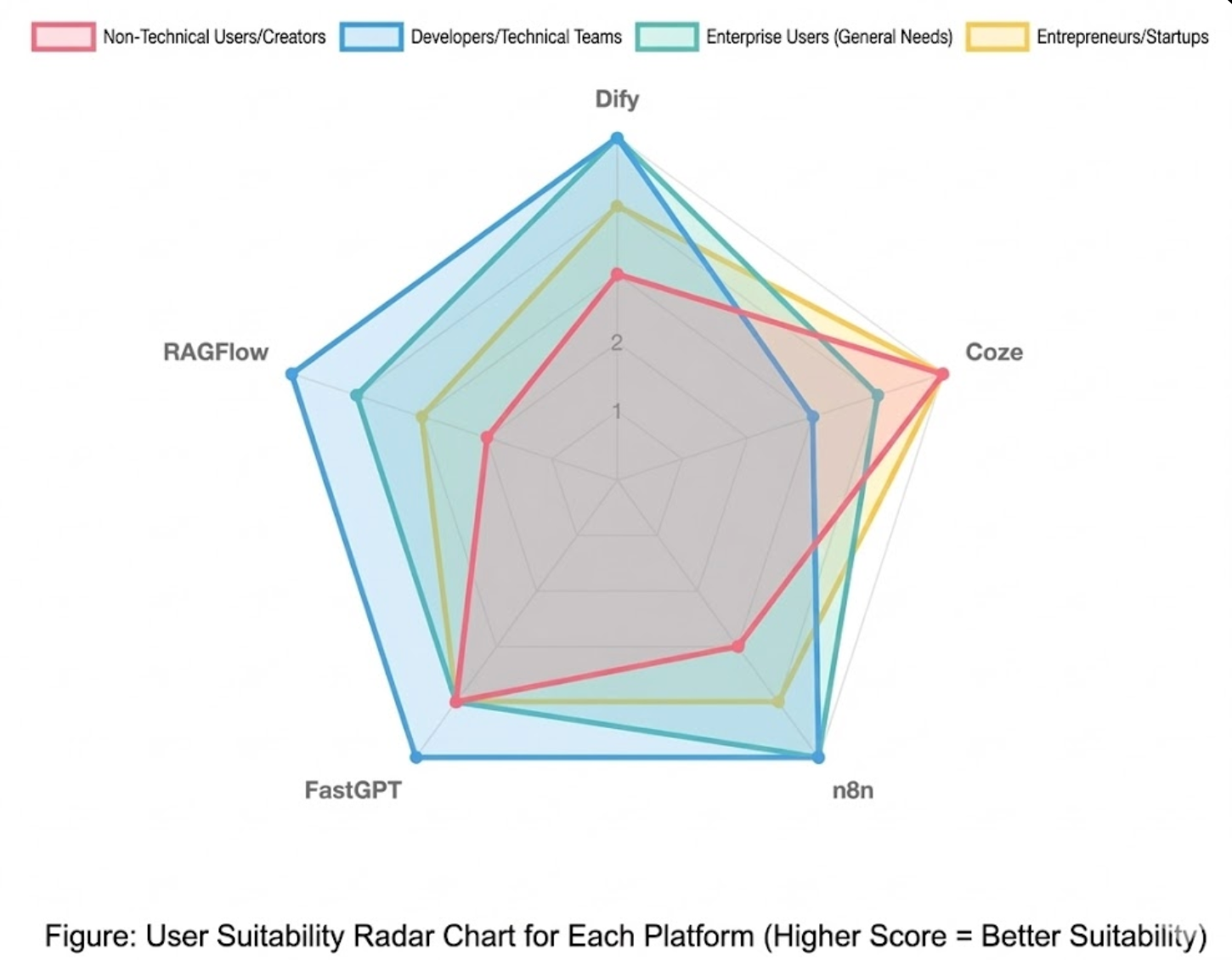
This article focuses on WebUI-based Open Source Workflow Platforms, providing a deep comparison of Dify, FastGPT, and RAGFlow.
Quick Selection Guide:
- Focus on Workflow Orchestration & Extensibility ➔ Choose Dify
- Focus on Deep Knowledge Base & Document Parsing ➔ Choose RAGFlow
- Focus on Quick Deployment & Simple Q&A ➔ Choose FastGPT
Evaluation Versions & Criteria
This review is based on the following versions:
- Dify: v1.0.0
- FastGPT: v4.8.20
- RAGFlow: v0.17.0 slim
We will analyze them across multiple dimensions including team management, model support, external tools, knowledge base, application management, open-source licensing, and deployment complexity.
Detailed Assessment
1. Team Management
Collaboration capabilities are the foundation of enterprise applications.
| Feature | Dify | FastGPT | RAGFlow |
|---|---|---|---|
| Workspaces | 1 | None | Multiple (Invite only) |
| Roles | Admin / Editor / Member | None | Admin / Member |
| Multi-Team | Not Supported | Not Supported | Supported |
| Rating | ★★ | ★ | ★★ |
Verdict: Dify has clearer permission separation, suitable for single-team collaboration. RAGFlow supports multiple workspaces, making it better for outsourcing or parallel project scenarios.
2. Model Management
The breadth of model support determines the platform's potential.
| Feature | Dify | FastGPT | RAGFlow |
|---|---|---|---|
| Providers | 56 | 20 | 44 |
| OpenAI Compatible | Supported | Supported | Supported |
| Extensibility | High (Plugins) | Medium | Low |
| Model Types | Text / Image / Audio, etc. | Text / Image, etc. | Text / Image, etc. |
| Rating | ★★★ | ★★ | ★ |
Verdict: Dify demonstrates overwhelming advantage in its model ecosystem, supporting the largest number of vendors and modalities.
3. External Tool Integration
The ability to connect to the outside world determines an Agent's practical value.
| Feature | Dify | FastGPT | RAGFlow |
|---|---|---|---|
| Standard Tools | 40+ (w/ strategies) | 15 | 21 |
| Extension | API / Plugins | None | None |
| Key Features | Strong DB Connect / JSON | Commercial Tools | Academic Search |
| Rating | ★★★ | ★★ | ★ |
Verdict: Dify possesses the richest toolbox and supports extension via APIs and plugins, making it ideal for building complex business flows.
4. Knowledge Base (RAG)
This is the core battleground for Retrieval-Augmented Generation applications.
| Feature | Dify | FastGPT | RAGFlow |
|---|---|---|---|
| Formats | 12 types | 9 types | 6 types |
| Import Methods | Web / API / Notion | Text / API | Web / Docs |
| Core Tech | Vector Search | Vector Search | Knowledge Graph + Deep Doc Parsing |
| Rating | ★★ | ★ | ★★★ |
Verdict: RAGFlow wins hands down here. While the number of supported formats looks average, its Deep Document Understanding (DeepDoc) and Knowledge Graph capabilities make it perform far better than competitors when dealing with complex unstructured data.
5. Application Management
| Feature | Dify | FastGPT | RAGFlow |
|---|---|---|---|
| App Types | Chat / Agent | Workflow | Chat |
| Workflow Features | Error Handling / Parallel / Logic | Basic | Basic |
| Extensibility | Plugin Support | Contributable | None |
| Rating | ★★★ | ★★ | ★ |
Verdict: Dify's Workflow Orchestration capabilities have reached a commercial grade, supporting complex logic control, making it the top choice for building true Agent applications.
Licensing & Deployment
- Dify: Allows commercial use (restriction on multi-tenant SaaS operations).
- FastGPT: Allows commercial use (prohibits building competitive services).
- RAGFlow: Permissive license, allows free redistribution.
Deployment Complexity: All three support Docker containerization with relatively similar barriers to entry.
- Dify: Tech stack is Python / Next.js.
- FastGPT: Depends on MongoDB.
- RAGFlow: Depends on MySQL and Elasticsearch/InfiniFlow.
Summary
Here is the comprehensive performance summary of the three platforms:
| Dimension | Dify | FastGPT | RAGFlow |
|---|---|---|---|
| Team Management | ★★ | ★ | ★★ |
| Model Management | ★★★ | ★★ | ★ |
| Ext. Tools | ★★★ | ★★ | ★ |
| Knowledge Base | ★★ | ★ | ★★★ |
| App Management | ★★★ | ★★ | ★ |
Final Conclusion:
- If you need to build an AI Agent with complex functions, rigorous logic, and external tool connections, Dify is currently the best choice.
- If your core pain point is precise retrieval from massive complex documents (e.g., legal papers, industrial manuals), RAGFlow is irreplaceable.
- If you just need a simple, quick-to-deploy internal Q&A bot, FastGPT is a lightweight and convenient option.